
Walker Fletcher
Date of birth: 1887
Date of death: 18.12.1917
Area: Normanton
Regiment: King's Own Yorkshire Light Infantry
Family information: Third child of Abraham and Isabella Fletcher
Rank: Private
Service number: 201078
War Service
Soon after the Declaration of War in August 1914, Lord Kitchener launched a campaign asking men to join the armed services, even though there was a need to increase the production of coal to fuel the war effort. The men to mine coal were also important for the nation. It is not known when Walker responded to the slogan “Your Country Needs You”, but he enlisted at Normanton into the 2nd/4th Battalion King’s Own Yorkshire Light Infantry.
The battalion landed at Le Havre on 15 January 1917. In November 1917, the 1st/4th and 2nd/4th Battalions were fighting together near the village of Havrincourt during the Battle of Cambrai and the capture of Bourlon Wood (27-28 November). The army had adopted new tactics with the introduction of the then new invention “the Tank”. During this time the 2nd/4th Battalion suffered heavily during the one-to-one fighting.
Precisely when and where Walker sustained his injury is unknown. Prior to the discovery of antibiotics, which only became readily available in World War Two, even a small injury could be fatal. Walker died of his wounds on 18 December 1917, possibly after the Battle of Cambrai or Bourlon Wood in late November. Walker Fletcher now rests in the Etaples Military Cemetery, France.
Etaples is a town 27 kilometres south of Boulogne, only a two-hour drive from Cambrai today.
Private Walker Fletcher is one of 10,771 Commonwealth burials of the First World War in Etaples Military Cemetery.
The inscription on his headstone reads:
“Until the day breaks and the shadows flee away.”
During the First World War, in the area around Etaples, troops were camped among sand dunes and the hospitals. The hospitals included eleven general, one stationary, four Red Cross hospitals and a convalescent facility and were capable of attending to 22,000 wounded or sick. The site was remote from attack, except from aircraft and accessible by railway from both Belgium and France.
Family Life
Walker was born in Altofts in 1887, the third child of Abraham and Isabella Fletcher who were both born in Wakefield. Abraham married Isabella Wood at Saint Mary Magdalene Church, Altofts on 29 July 1883, at that time Albert worked underground at the coalface, coming home to live on Birkwood Road. The address recorded in 1891 was The Robin Hood Yard, Altofts. By this time the family had grown with the birth of Ellen and John, then Walker followed by Florence, Fred and Tom. By the time of Tom’s baptism on 1 August 1891 the family had moved to live at 20 Bastows Yard, Altofts. During the next ten years the family moved again, this time to 21 Greenbank Road, Altofts and there were further additions to the family. Isabella gave birth to Ernest, Alice Lucy and Carrie in 1902. Earlier records show eleven children, however by 1911 only eight were still living – sadly Ellen, Florence and Ernest do not appear on the 1911 census records. The family home at Greenbank Road would be the last home for Walker, but for now, in 1911, Abraham was still working at the coalface as a hewer and Walker and his brothers had joined him to work in the mine. Walker had seen many changes in his life and he had worked in a dangerous environment, but nothing could prepare him for the catastrophic changes that were to occur during the next few years.
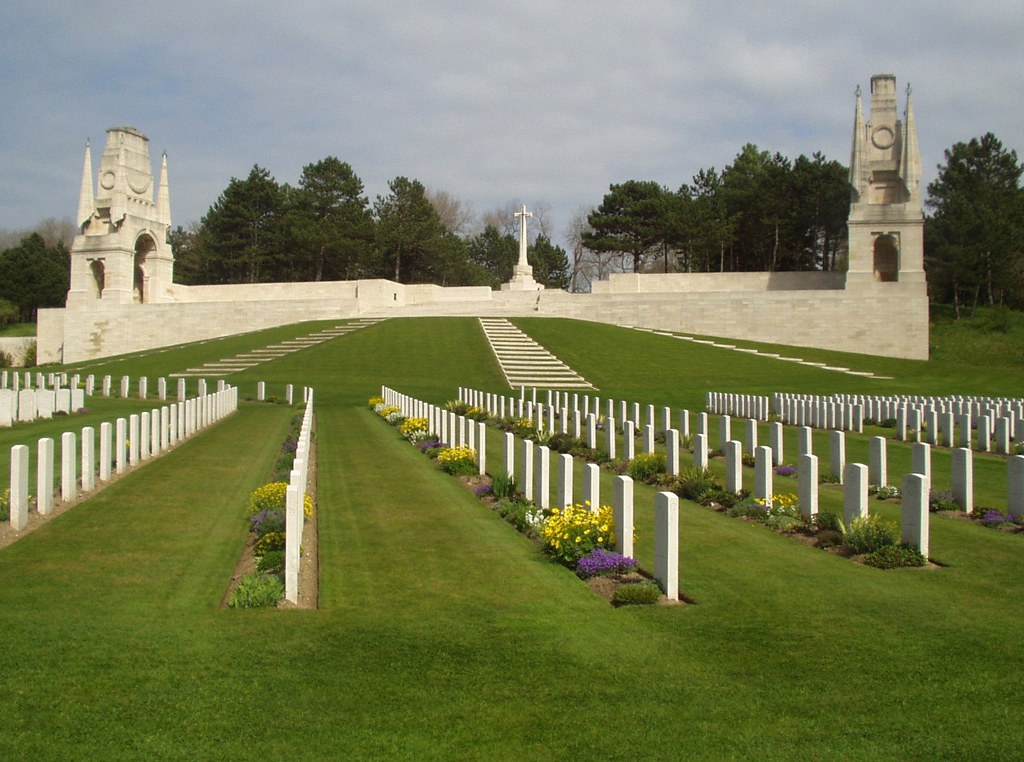 Etaples Military Cemetery