
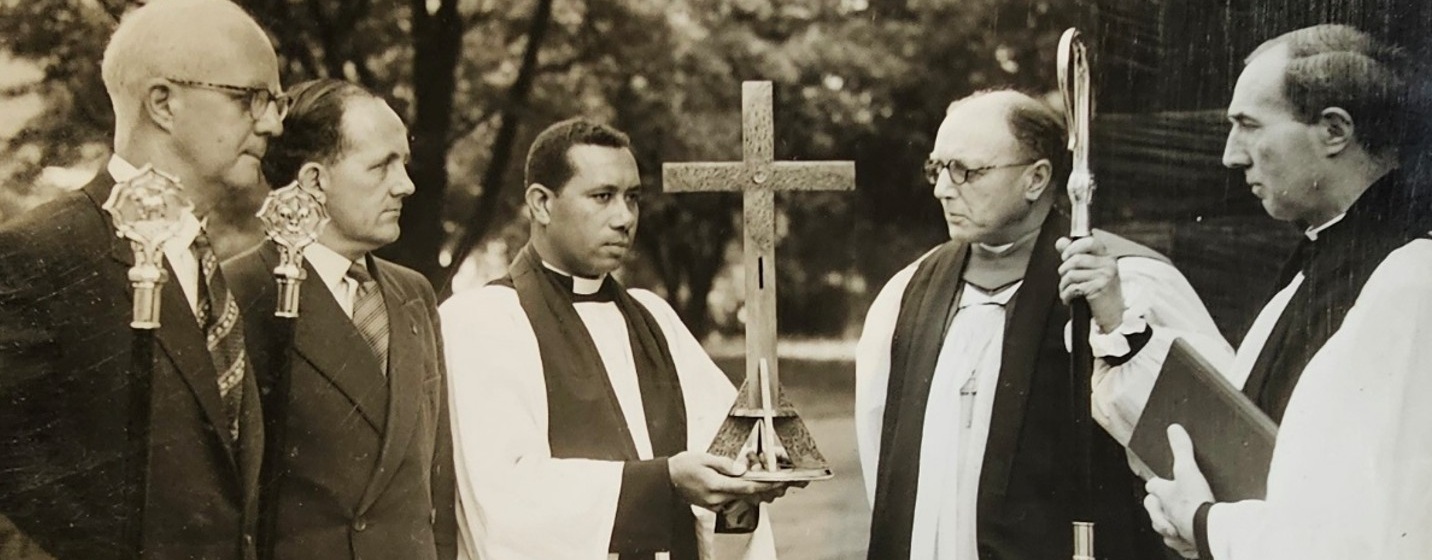
Archdeacon Arnold Hollis (1933 - 2026)
For at least 2000 years, people have come from across the World to live and work in Wakefield district. Their stories are an important part of our shared past. They have shaped our culture and made our district the vibrant place that is today. For some, the district also shapes them and leaves a lasting legacy. One of these people is Dr the Venerable Arnold Thaddeus Hollis, curate at St John’s Church in Wakefield in the 1960s. His story has been researched by Elizabeth Oldroyd, retired church warden at St John’s.
Blog by Elizabeth Oldroyd, St John’s Church, Wakefield with additional information from the Wakefield Libraries Local Studies collection.
I emailed Dr the Venerable Hollis in 2022 about an old black and white photograph in St John’s archive. He kindly emailed back to confirm that he was the curate in the photograph. He was shaking hands with Reverend Harrison, Vicar of St John the Baptist Church. This event marked the beginning of his curacy at St John’s, his first posting after being ordained deacon. He was ordained to the priesthood by Bishop Ramsbottom at Wakefield Cathedral on December 18, 1960. In his email he noted that his time at St John’s Church as Curate were two of the most meaningful years in his faith journey, allowing him to be chartered through his priestly formation by a most gentle Rector, and with the love and care of many parishioners. He fondly remembered Eddie and Winnie Ryder and Ruth Brummitt. He also commented that his ministry at St John’s Home for Girls set him on a path of specialised Prison Ministry for 61 years, along with Hospital Chaplaincy after his work at Pinderfields General Hospital. His time in Wakefield therefore, although relatively short, helped to shape his future career in many ways.
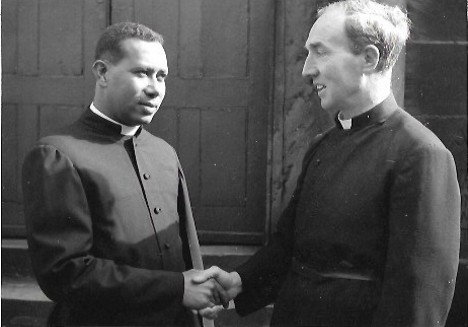 Photograph of Dr the Venerable Arnold Hollis and Reverend Harrison at St. John’s Wakefield in 1960 (from St John’s church records)
Arnold T. Hollis was born in Bermuda in the West Indies in 1933. He wrote that he had a feeling from being a boy he wanted to be a priest in the Church of England. People laughed at the idea. It was a time of racial segregation with few people of colour within ordained ministry in Bermuda’s churches. “Here was this little black kid, trying to think he could be a minister in what was considered a white, elite church, so to speak. But I was drawn to the Anglican Church because I felt it had a true picture of what Jesus’ ministry was about. And I liked the axiom of the church - the church to teach, and the Bible to prove.”
Arnold graduated and became a teacher, but his desire to enter ordained ministry remained strong. A local parish priest and Archdeacon helped him to get into Theological College in Barbados in 1956, later moving to England. After his two-year curacy at St John’s and ordination at Wakefield Cathedral he wrote back to the Bishop of Bermuda, hoping to return, but he was told there were no places available. He was told he could stay in England or go back to the West Indies. This went on for 17 years. He intended to go to Barbados but ended up at a Mission Church in Guyana. He then returned to Wakefield District for 3 years, first as curate at St. Peter’s Horbury in 1964, and then as priest at St. John’s Horbury Bridge 1964-67.
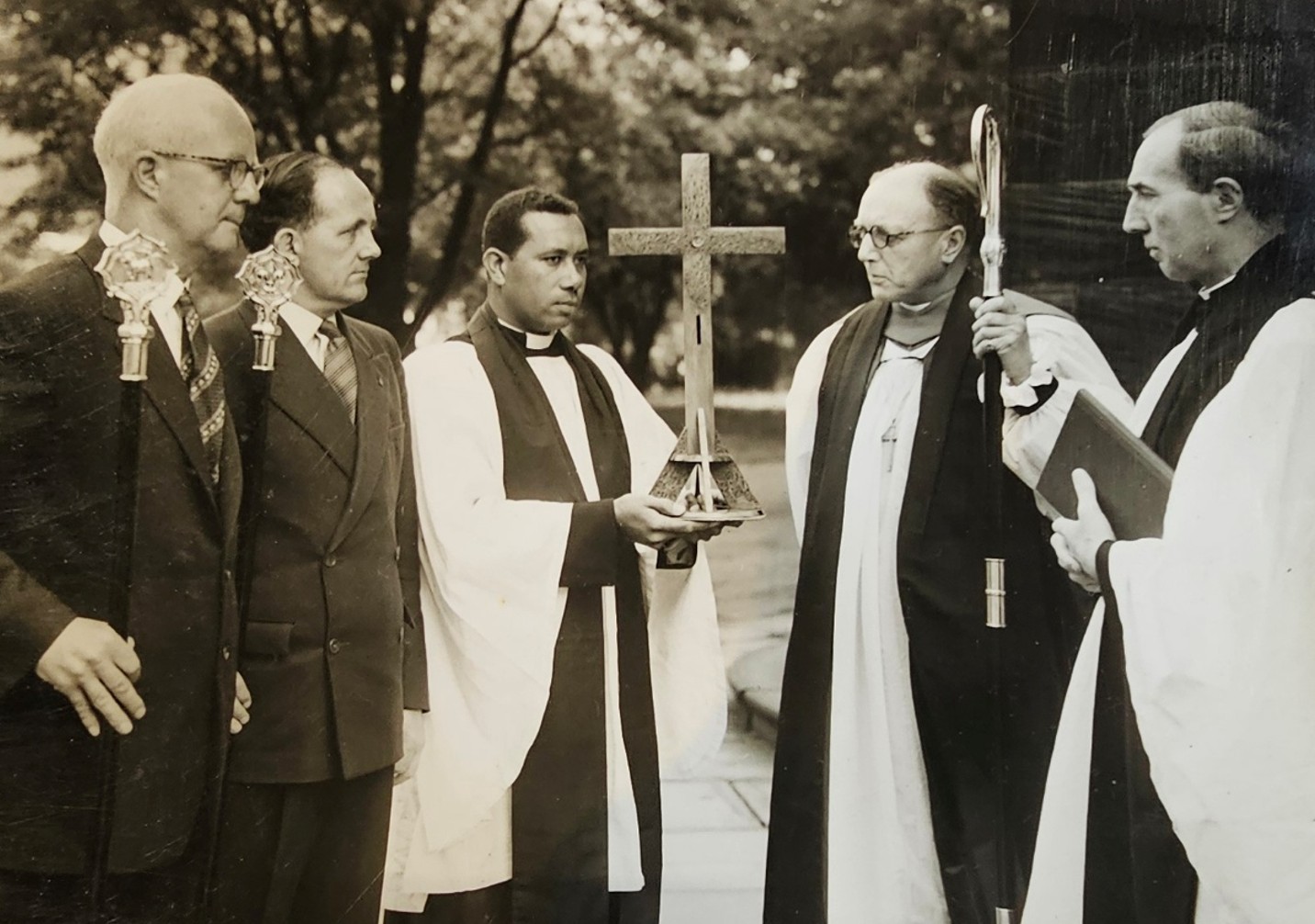 Photograph of Dr the Venerable Arnold Hollis at St. John’s Wakefield (from St John’s church records)
In 1969 he married and moved to Philadelphia, USA, later moving to New Jersey, all the while trying to return to Bermuda. Each time told there was no place available, or that he wasn’t qualified enough. No to be deterred, Archdeacon Hollis went back to school and took a degree in Sociology, two Masters of Divinity and a Doctorate in Parish Ministry and Church Administration. He wrote ‘Ironically, the next time I applied for a position in Bermuda, I was too qualified.” In 1976 two vacancies did come up in Bermuda. He spent 6 months travelling between the two Parishes, until he was eventually hired. He became very active in the Anglican Church of Bermuda and his own Parish community, also serving as Chaplain for the former Prison and HM Navy. He was nominated for the position of Bishop of Bermuda on 3 occasions. In 1997 he became Archdeacon of Bermuda, a position he held until 2004.
Archdeacon Hollis retired in 2020 to spend more time with his family. His wife, Janice D. Hollis, a medical social worker, passed away in June 2021, leaving 3 daughters and 6 grandchildren. One of their daughters became a priest in California in 2010, the first Bermudian Anglican woman minister. It was only in 2010 that the Anglican Church of Bermuda overturned 400 years of tradition and voted in favour of allowing women clergy by a majority vote. In 2020, Archdeacon Hollis aged 86 years attended a Black Lives Matter march despite concerns about Covid-19. He vowed “I’ll be there - even if someone has to push me in a wheelchair.”
Archdeacon Hollis passed away in January 2026, aged 93 years.
St John’s the Baptist Church in Wakefield is an Anglican Church, originally built in 1795 as the centrepiece of a new Georgian housing development on the edge of the medieval city. It was designed by architect Charles Watson and is a Grade 2* Listed building. find out more about St John’s: St John’s Church, Wakefield.
St John’s Girls School was founded on St John’s Square as a ‘house of refuge’ for young women released from prison in 1848. In 1856 it was repurposed as a reformatory, or a place where young offenders (in this case young women) were sent as an alternative to prison. In 1921 it was transferred to the Wakefield Diocesan Council for Rescue and Prevention Work. In 1937 it became an Approved School for girls aged 15-17. It closed in 1981. The records for the school are held by the West Yorkshire Archive Service.