
Walter Statham
Date of birth: 1897
Date of death: 7.7.1916
Area: Normanton
Regiment: King's Own Yorkshire Light Infantry
Family information: Second child of Dan and Harriet Emmaline Statham
Rank: Lance Corporal
Service number: 3026
War Service
Walter enlisted at Normanton and given the number 3026 when he joined the 1st/4th Battalion King’s Own Yorkshire Light Infantry, possibly on the same day in December 1914 when Private 3022 John Edwin Steel joined the same battalion. The 1st/4th Battalion King’s Own Yorkshire Light Infantry was established in Wakefield in August 1914 as part of the 3rd West Riding Brigade, West Riding Division. On mobilisation the battalion moved to Doncaster in November 1914, then to Gainsborough and finally to York in February 1915 before embarking for France. The battalion landed at Boulogne on 12 April 1915 but Walter remained in England, possibly until after his birthday, arriving in France on 9 July 1915. Officially, young men under the age of 19 years could not serve overseas. However, Walter may have been one of the thousands of young men who were so eager to respond to the recruiting slogan “Your Country Needs You” that they lied about their age – Walter was born in July 1897 and arrived in France in July 1915, therefore he would have been only 18 years old.
During the next twelve months, the battalion took its turn in the trenches and continued to train for an attack. All ranks knew a big offensive was coming but only a few high rank officers knew when.
The 1st/4th Battalion King’s Own Yorkshire Light Infantry arrived in the assembly trenches in Aveluy Wood at 03.00hrs on the morning of the 1st July 1916. Walter’s was a reserve battalion and did not participate in the initial attack. At 7.30am, the whistles sounded for the men of the attack battalions to leave the trenches and go “over the top”, advancing slowly towards the German lines – the start of what became known as the Battle of the Somme, one of the most infamous battles of the First World War.
The men who went “over the top” at 7.30am were told, and believed, there would be little resistance from the Germans after being subjected to the British heavy artillery barrage during the previous hours. They were wrong! The German defences were deep and strong. After the bombardment ceased the German forces had sufficient time to leave their deep dugouts and move machine guns into positions ready to repel the advancing British and Commonwealth troops. By the end of that first day there were 57,470 casualties including 19,240 fatalities.
For over ten hours 18 year old Walter with his battalion waited for their orders to go “over the top”, now they knew what they were about to face. They witnessed the carnage and the wasted lives of young men as the waves of British and Commonwealth troops left the trenches and advanced over no man’s land to face the German bullets. Finally, the waiting was over. At 6.00pm on 1 July 1916 the order came for Walter’s battalion to go “over the top” into no man’s land. Along with other battalions, they attacked the small village of Thiepval. The following morning, 2nd July, they were holding trenches in Thiepval Wood. Throughout the night until 5.00am the following morning, they endured heavy shelling from the German artillery. During the next few days, there was intense fighting in the near vicinity. At 0.30am on the 7 July 1916, the Germans started a bombardment on the British lines and again intense fighting took place until 6.30am that morning. When the battalion finally pulled back into the trenches in Thiepval Wood the battalion had suffered 180 men wounded and 20 killed. Walter, then 19 years old, was one of those killed. Although not named, records suggest that Walter was one of the 20 men killed during the action on 7 July 1916.
At the end of September Thiepval was finally captured – the village had been an original objective of 1 July 1916. The Battle of the Somme finally ended on 18 November 1916.
Walter Statham is one of more than 72,000 officers and men commemorated on the Thiepval Memorial to the Missing of the Somme, who died in the Somme Sector before 20 March 1918 and who have no known grave. Over ninety percent of those men named died between July and November 1916.
A small cemetery containing equal numbers of Commonwealth and French graves lies at the foot of the memorial.
Family Life
Walter was born in Altofts in 1897 the second child of Dan and Harriet Emmaline Statham. When Dan married Harriet Emmaline Shaw in All Saints Parish Church, Normanton on 11 July 1894, they were both residing at 17, Altofts Road in Altofts. One year later Harriet gave birth to their first child Lydia Ann in 1895. Harriet gave birth to their third child, Frank, on 4 March 1901.
By April 1911 Dan, Harriet and their two boys, Walter aged 13 years and 10 year old Frank, had moved to live at 35, Lee Brigg, Altofts. Walter’s older sister Lydia had left the family home to find employment as a domestic nurse for a bank manager’s family in Headingley, Leeds. Dan had gained promotion from railway fireman to railway driver. Sometime after 1911, Walter’s parents moved home again, this time to live at 36, Croft Avenue, Altofts.
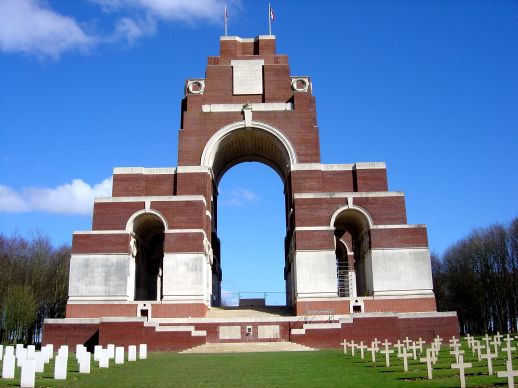 Thiepval Memorial