
Thomas Leslie Lees
Date of birth: 1888
Date of death: 23.7.1916
Area: Normanton
Regiment: King's Own Yorkshire Light Infantry
Family information: Husband of Cecily Lees nee Eames
Rank: Company Sergeant Major
War Service
Thomas joined the 3rd Battalion King’s Own Yorkshire Light Infantry, a regular reserve battalion at Pontefract in 1914.
By 1915 Thomas was now a recruiting Lance-Sergeant stationed at the Olympic Skating Rink in Sheffield with the 4th Battalion King’s Own Yorkshire Light Infantry. The phrase on Thomas’s college report card “He was not good at imposing discipline” may have had an influence on the Army’s decision for Thomas to remain as a Lance Sergeant rather than an officer, which as a minister’s son and his Grammar School education, office rank would have been normal. On 20 February 1915 at the Zion Chapel, George Street, Wakefield, Thomas married Cicely Eames of Station House, Normanton and the daughter of Spencer P Eames, proprietor of the Normanton Advertiser Office.
Thomas arrived in France with the 1st/4th Battalion King’s Own Yorkshire Light Infantry on 13 April 1915, only 52 days after his marriage to Cicely. The battalion, now part of the 49th West Riding Division, was soon to see action. Confirmed in a letter to the headmaster of Normanton Central Council School published in the Wakefield Express 8 May 1915:
“THE GREAT DARING OF OUR AIRMEN FLYING OVER THE TRENCHES WITH SHELLS BURSTING ALL AROUND. A NORMANTON TEACHER IMPRESSED
T L Lees, one of the 1st 4th Battalion K.O.Y.L.I., at the front, an assistant master at the Normanton Central Council School writing to the headmaster (Mr F Thorne) on the 23rd ult. Says:
“I have had my first experience of being under fire, I was in the first line of trenches and came out on Wednesday night, I had a dose of shrapnel on Wednesday morning and we were shelled for twenty minutes.
We landed in **** when we came and slept the first night in a rest camp, the next day we were packed into cattle trucks – forty men in each – and carted up the country to ****. We stayed the night here and next day moved off nearer the firing line.
You will be wondering what I felt like in the firing line. My feelings were rather doubtful at first. Everybody appeared to be in a *funk, but all tried their best to make everybody else think they were not, until the situation became a scream. Going up into the firing line we had a lively time; a few stray bullets came whistling and crackling about our heads. The worst experience is going into the trenches and coming out, otherwise actually in the trenches it is not too bad. The dug-outs are comfortable places and you can have quite a nice sleep in spite of the din around you. I should not be speaking the truth if I did not say I was glad when I got out but it was only happiness that one feels after having done a day’s work.
We shall be having another dose soon and I shall be doing shifts on and off – so many days in the trenches and so many out.
We are treated every day to some wonderful exhibitions of flying. Who said we were behind in flying? Who said our chaps couldn’t fly? I saw one chap the other day fly over the German trenches and go along them, followed by a continual hail of shells – some (??) in all. When he was returning, shells were bursting all around him but in spite of all this he did this on three successive occasions. This is more or less an everyday (??) with them.”
(*a “funk” (noun) according to the New English Dictionary published 1932 is;
A state of fear or panic; a coward. As a verb it is to be in a state of terror; to flinch, to shrink in fear or cowardice, to be afraid of; to shirk, to try to evade through fear or cowardice.)
As part of the 49th West Riding division the battalion saw their first major action in the Battle of Aubers Ridge. During this battle the division lost 94 men including two officers.
In the War Diary/Intelligence Summary for the Ypres-Boesinghe Line, dated 19.12.15 the name of Sgt T. L. Lees appears in a section recommending Officers, N.C.O.’s and men for good work. Thomas received a gallantry card from the Divisional Commander.
The War Diary entry for 19.12.15 also lists the following:
“Casualties: Died of Gas Poisoning – 1 Officer and 23 other ranks
Killed in action – 6 other ranks
Wounded – 1 Officer (later died of wounds) and 19 other ranks
Wounded-Gas – 2 Officers and 149 other ranks.”
Throughout the winter no major offensives took place except the day-to-day sniping, gas and raiding parties continued.
The following are extracts from entries in the Battalion diaries:
“Somme Area
22.7.16 11am Battalion in front line
10pm. Received orders to attack at 2.30 am.
23.7.16 2.30am. The attack was met by rifle fire and a barrage of shrapnel and attacking party suffered heavy casualties crossing No Man’s Land. On arrival at the German lines, the enemy was found in force and owing to the casualties sustained, the party was too weak to put up a fight and withdrew. The enemy bombers counter attacked up trenches leading to our lines but were driven off by our bombers.
CASUALTIES ; Other ranks 6 killed; 60 wounded.”
Thomas is reported to have been killed in action on 23 July 1916 near Authuille, possibly one of the six men killed during the action on the night of 22/23 July 1916.
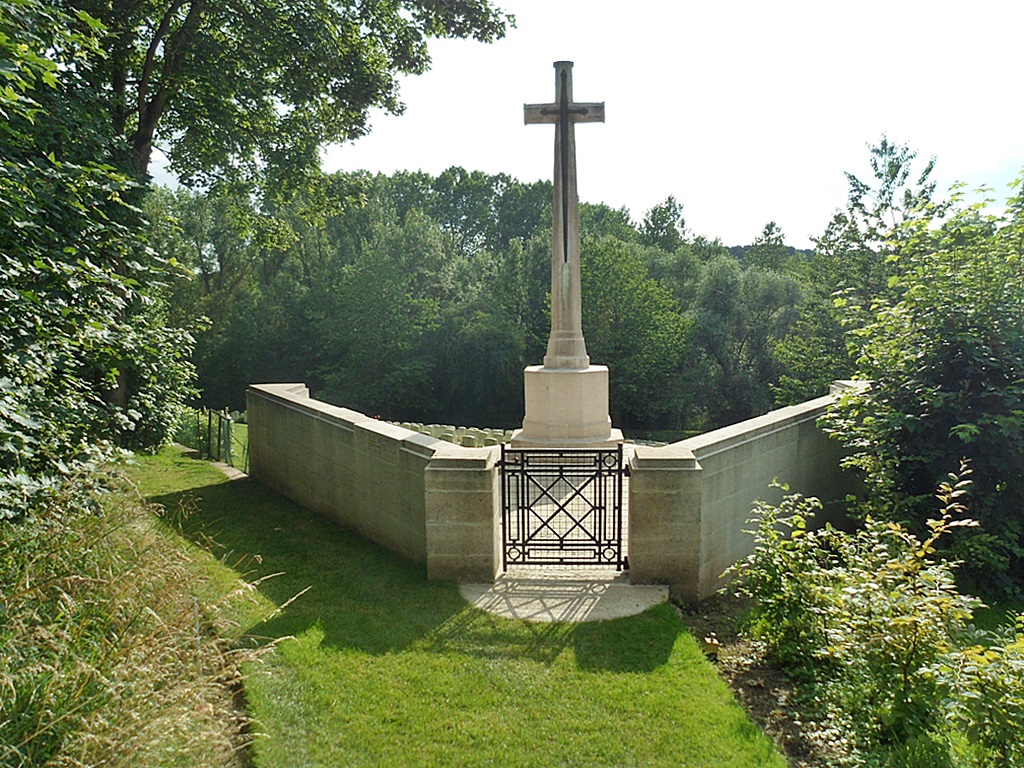
Thomas is buried in Authuille Military Cemetery in France. The inscription on Thomas’ headstone reads, “THEIR GLORY SHALL NOT BE BLOTTED OUT”.
The Commonwealth War Graves Commission has also inscribed “Known to have been buried in this cemetery”. Some early casualties were buried in cemetery land that was fought over during later periods of the war. Often shelled and destroyed, Authuille village was held by British troops from the summer of 1915 to March 1918, when it was captured in the German spring offensive on the Somme.
The Military Cemetery was used by Field Ambulances and fighting units from August 1915 to December 1916 and in 1917 and 1918 by Indian Labour Companies. There are now over 450, 1914-18 war casualties commemorated in this site.
The following appeared in the Wakefield Express on 29 July 1916:
“MORE NORMANTON MEN KILLED IN ACTION
POPULAR SCHOOL TEACHER IN THE LIST
There have been further casualties reported in the Normanton district this week, three men having been reported as killed in action.
One of these is Company Sergeant Major Thomas Leslie Lees of the K.O.Y.L.I. (Wakefield Territorial’s) than whom there was no more popular Normanton soldier. He was the only son of the late Rev. T. Lees of Pollington and for many years pastor of the Normanton Congregational Church. The deceased soldier, who prior to the outbreak of war was on the teaching staff of the Normanton Central Council Mixed School, is reported to have been killed on the 23rd inst. Much sympathy has been expressed during the week-end with the young widow, who is a member of a well-known Normanton family. Company Sergeant Major Lees’ death is a great loss to Normanton.”
Family Life
Thomas Leslie was born in Whalley, near Blackburn, Lancashire in 1888, the son of Thomas and Sarah Lees. By 1901 the Lees family had moved to live at number 10, The Grove, Normanton. Thomas’s father, the Reverend Thomas Lees, was for many years the pastor of Normanton Congregational Church. Young Thomas and his two sisters, Kathleen and Dorothy, grew up in Normanton, where Thomas attended Normanton Grammar School.
However, in 1910 the family moved to live in Pollington near Snaith when the Rev Thomas Lees took up the role of the Congregational Minister. Sadly, only two years after moving to Pollington, Thomas’s mother Sarah died.
Thomas continued with his education at the Diocesan Training College in York, to become a teacher. A college report card described Thomas as having a “pleasant manner” but noted that “he was not good at imposing discipline” and that though occasionally very successful with teaching, “he does not prepare consistently well”.
After successfully completing his education, Thomas returned to Normanton and became a teacher at the Normanton Central Council Mixed School.
In 1911 Thomas lived in rented accommodation with Samuel and Alice Musgrave’s family at 26, Cambridge Street, Normanton, presumably to be near his place of work and perhaps to renew friendships.
 Authuille Military Cemetery